The lengths to which “publishers” will go to publish ads on the web is pretty infuriating sometimes. “Publishers” in this sense are people like me, publishing stuff on the web, whether it’s my opinion on what the dickheads of the world are up to as they try to ruin this planet, or information on how your app works or the news of the world. All of that is useful information, often that shows up as search results, and I suppose it’s legitimate for the publishers of that information to expect to be paid for that information commensurate with what they have to pay data centres for bandwidth and (in the case of the BBC) stationing journalists all over the world to report on news.
But it’s also reasonable for me, as the owner of the device of which said ads are being displayed, to restrict publishers from using the cycles of my device’s CPU to sell their products or services or the bandwidth that I have to pay my ISP to download their ads. The latter is not insignificant.
And that is what I have done for years.
For many years I have used the “hosts” file at winhelp2002.mvps.org. Unfortunately, the guy who used to run that appears to have died. I did donate to his project (back when I had money) and, when his medical problems became clear, offered to help and (if necessary) take over the project, but he never replied to my email. Now that he’s gone, his file has languished un-updated since March 2021, and yet the world has moved on in the five years since then. Advertisers register new domains every day to serve up their ads, and so I see new ads occasionally because their new domains aren’t blocked.
I’m convinced that I don’t see half of the crap online that most people see. I credit the “Criteria for detection for the MVPS HOSTS File” for this, and the fact that I can (and do) edit my own HOSTS file to blackhole domains of my choice.
The one thing I have never done is use a program like Pi-hole to block advertising on my whole network, including my cell (mobile) phones and tablets and the devices of everyone in my household. It’s not because I’m morally opposed to using them, but because I feel I have more control over the “hosts” file on my own machine. I have a script that very quickly moves my “hosts” file out of the way and puts in my default “hosts” file, and I don’t know how I’d accomplish that same thing on a network-connected device, such as a router. It will be the first thing I research if I ever do something to move into the modern world of ad blocking.
I’m also worried that doing so might negatively affect how some apps operate, but you don’t know until you try. If you have experience using a mainstream (Android or Iphone) device on a Pi-holed network, I’d be interested in your opinion. Changing my phone to a non-mainstream type is another thing I plan to try before I die.
Speaking of the lengths to which “publishers” — in this case actually the advertisers — will go, they register domains and just park generic pages at the root of the domain. Here’s one of them:
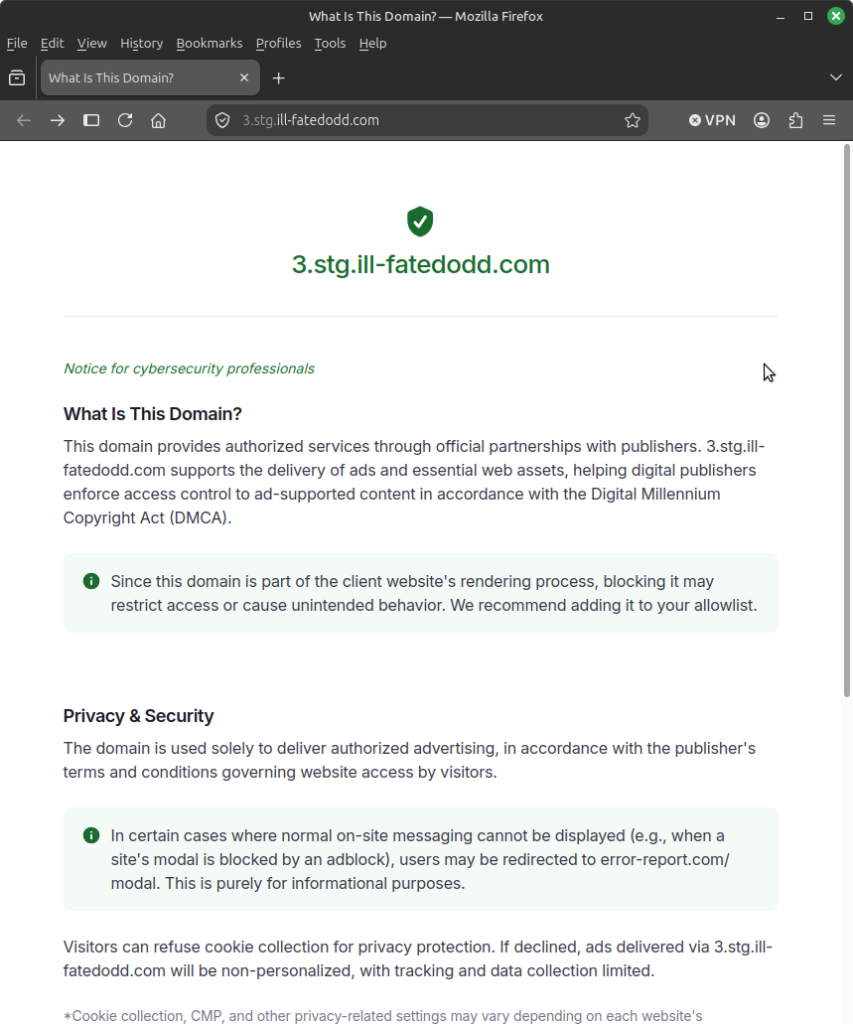
ill-fatedodd.com screenshot.
(If you’re not blocking advertising domains, you can see this page in full at 3.stg.ill-fatedodd.com. Here’s another one from another company: www.chaseherbalpasty.com.)
In their verbiage, they refer to a laughable “legal notice” — they title the page as a “Notice for cybersecurity professionals” — where they plead for their domain not to be blocked:
Any attempt to bypass or interfere with a website’s intended functionality or technical protection measures (including adding this domain to a blocklist) may violate the DMCA and the publisher’s Terms of Service, and may result in restricted access to the service.
Publishers delivering ads through this domain reserve the right to take necessary actions, in accordance with applicable laws and policies, to ensure the stable provision of services.
In other words, “Please, pretty please, don’t block our advertising.” If I operated a huge network and I didn’t want to inconvenience (or support) my users, I’d probably pay attention to this notice. But if I’m just trying to block advertising on my own computer (and possibly, in the future, my own small network), this is inconsequential to me. Only once in my life have I run into a situation where a business seemed to rely on an advertising domain in my blacklist to achieve some sort of function that blocked me from logging into my pre-existing account, and for those of you who work in this business, it won’t surprise you that that business was Godaddy. But they must have stopped using that blacklisted domain at some point, because after using my naked “hosts” file to get around the problem for a while, I eventually seemed able to log into their website with my full blacklist in place. No harm, no foul; I got to carry on blocking advertising and I got to carry on using my Godaddy account.
One consequence of this block, for me, is that I either have no or a very sparse profile with advertisers. I just don’t exist in their books. If you think, “Well, I hardly ever browse the Web, so they’ve got nothing on me,” then you’re wrong. They do. Even in my case, I received an email from a cousin (who uses a gmail.com address) that referred to Calgary Airport, and the same day I saw advertising for parking at Calgary Airport in an environment where I can’t currently block advertising (an Android phone). Gee, I wonder where Google made that connection?! I was also one of those suckers who used to have a very high opinion of Google, and so I was delighted one day to get an “invitation” to sign up for a Gmail address. I created, but never did use my account, except for one occasion on which I sent an email to a friend because my own mail server was down that day. One person, one email message! And yet, years later when I decided to close the account, I found that Gmail had created a hidden address book for me of dozens of people I knew! With their real email address! That I had never used with that account! And how the fuck did Gmail know that Bob Smith was my friend?! There was nobody in that hidden address book that I didn’t know, but none of them had ever received an email message from that address or had ever sent one to that address!
In another case, I broke my own rules and signed-up for a Facebook account because we were looking for a rental apartment, and we were told by “the kids” in the know that anything in the rental market happens in Facebook Marketplace. While I was in the first sign-up process, my application was blocked and my account suspended for “violating community guidelines”, even though I couldn’t have done so in the seven-tenths of a second I was a member. My second attempt a couple of weeks later was also unsuccessful and suspended for the same reason, even though the only thing I had managed to do was create an avatar. I’ve since been told that I was suspended because I didn’t make any “friends”, but that’s just speculation, not from the horse’s mouth. I think it’s more likely that, because I had (and have) facebook.com in my blacklist for the other 23.5 hours of the day I use the Internet, I looked suspicious to Facebook because I simply didn’t exist. No problem. I managed to find rental accommodation the old fashioned way (word of mouth), and to this day I have facebook.com (and other associated domains) blocked on my computer. No loss to me.
On the other hand, on the rare occasions I do see advertising, it is strangely apparent to me that they do know who I am. Is it just a coincidence that I see adverts for middle-age men, instead of (for example) skin creams for young 20-year-old women? No, sadly, it’s probably not a coincidence. Yes, I do have a prostate, thank-you very much, and yes it has been checked lately.
What this long (and meandering towards the end) post is supposed to communicate, is that it is possible (to a large extent, although not fully) to hide from advertisers and the purveyors of other crap, largely conspiracy theories. The impetus for this post is everything that is in the news these days (even tonight) about people, particularly kids, being subject to the whims of advertisers, whether those advertisers are advertising the latest skin cream (as mentioned above) or the latest conspiracy theory about Alberta separation, who really killed JFK, which race is really the master race or whether or not women should be kept barefoot and pregnant in the kitchen! My using blocks of huge (over 10 000 at this point) lists of blacklisted domains and just staying away from social media (easy for some of us to do) is a recipe for success for me. My IP address isn’t hidden from anyone, as the Vancouver Police Department has personally informed me, so I’m obviously not doing anything illegal, but I am obviously doing the best I can to hide myself from “surveillance capitalism”. And my success is seeing, on the news, that I’m not suffering from the same mental maladies that it seems afflict 90% of the rest of society.
Where this doesn’t help me is in dealing with friends who have become susceptible to the sewage they are fed. Unfortunately, having swallowed the Kool-Aid, they then assume that I have swallowed different Kool-Aid, and they completely discount my opinions. Two of my trump-supporting friends have ended a total of about eighty years worth of friendships with me recently because I won’t bow down and admit how great trump is. It’s shocking to me. That should cause me to have mental problems, not the sewage I don’t subject myself to online.
And to do this I am not restricting myself in any way. I (and my computer) do not load certain domains, and by not loading those domains my computer and Internet connection are faster and I am not subjected to the same sewage that the rest of the population is fed. In the famous words of donald trump, “Nothing bad can happen, it can only good happen.”